

Your Amazon PPC isn't a standalone engine; it's a high-definition amplifier for your brand's overall health. If the output is distorted, the problem usually isn't the speakers, it's the source. It's a hard truth to swallow when you're watching your dashboard turn red while ROAS tanks and organic rankings slip. You're likely asking, why is my amazon advertising not working, as you burn through capital with zero predictability. We understand the frustration of feeling like you're gambling rather than investing in your own growth.
We're going to stop the bleeding today. This isn't about minor tweaks; it's about identifying the technical leaks and strategic gaps that are draining your budget. You deserve a clear path to stabilized ACOS and revenue growth that you can actually forecast. We'll break down five mission-critical fixes for 2026 that will help you regain control of your account. From listing health to inventory alignment, we'll show you exactly how to plug the leaks for maximum ROAS and lasting market dominance.
Key Takeaways
- Diagnose if your campaigns are actually live by verifying delivery statuses and understanding the data latency that often triggers premature panic.
- Identify whether you have an ad problem or a conversion gap by auditing listing health and A+ content to ensure your clicks turn into customers.
- Stop the search term leak by moving beyond Amazon’s suggested bids and refining match types to answer the question: why is my amazon advertising not working?
- Uncover hidden revenue leaks caused by Buy Box loss and inventory gaps that render even the best PPC campaigns dormant.
- Recognize when to transition from DIY management to professional, multi-platform strategies to maintain growth as your monthly spend scales.
Technical Sanity Check: Is Your Amazon Ad Actually Delivering?
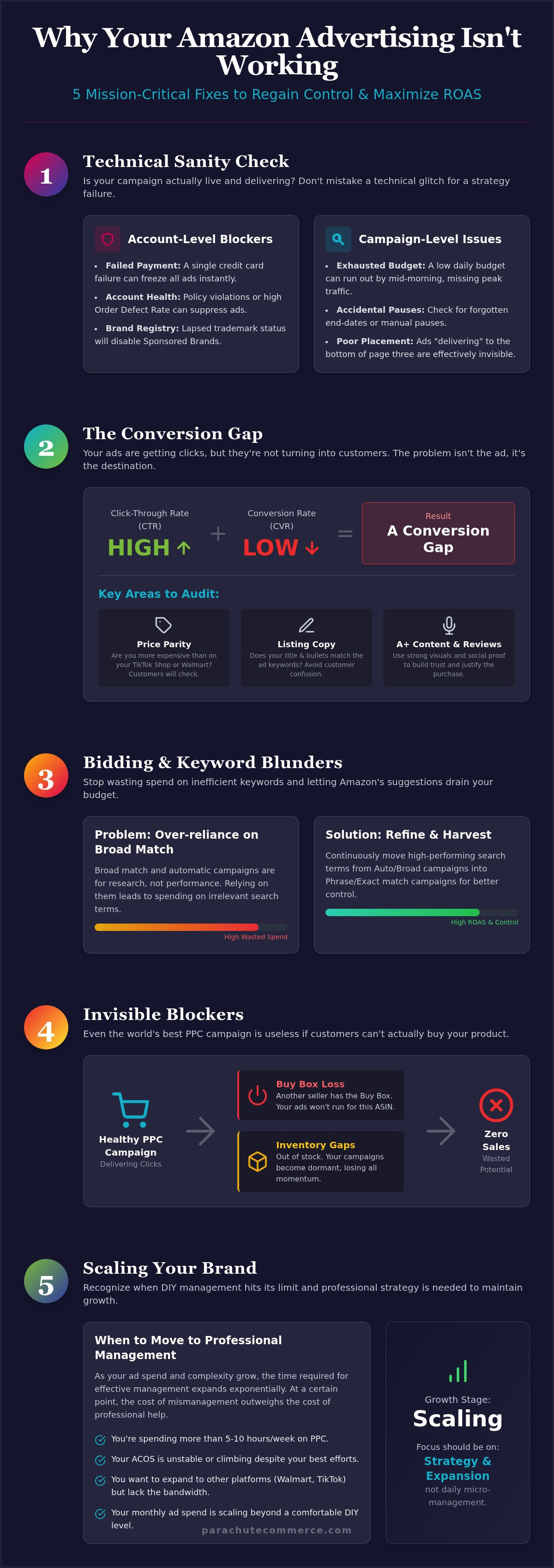
Before you dive into complex bid strategies, you must ensure the machine is actually turned on. Amazon's dashboard is often deceptive. A "Delivering" status doesn't always mean your ads are visible to customers at this exact second; it simply means the campaign is active and eligible. If you are staring at a blank performance graph and wondering why is my amazon advertising not working, the answer often lies in the basic plumbing of your account. You have to differentiate between a mechanical failure and a strategic one.
Don't let the reporting lag dictate your mood. Changes in Amazon's advertising business ecosystem don't reflect instantly. There is typically a one-hour delay between a bid adjustment and its impact on live auctions. If you check your stats five minutes after a change, you're looking at ghosts. Similarly, accidental pauses or forgotten campaign end-dates can kill your momentum. When a campaign stops, you lose the historical relevancy that helps keep your CPCs low. Restarting isn't just a click; it's a cold start for the algorithm.
Account-Level Blockers You Might Have Missed
Start with the most obvious but overlooked culprit: your wallet. A single failed credit card charge can trigger a silent account freeze. Amazon won't always send a high-priority alert for a payment failure, but they will stop every active campaign immediately. Verify your billing history and card validity before touching a single keyword. Next, audit your Account Health dashboard. Policy violations or a spike in your Order Defect Rate can lead to ad suppression. Finally, ensure your Brand Registry status remains active. If your trademark documentation has lapsed or been challenged, your Sponsored Brands and Video ads will simply disappear.
Campaign-Level Delivery Issues
The "Daily Budget" trap is a primary reason why is my amazon advertising not working for many growing brands. If your $50 budget is exhausted by 10 AM, you're missing the high-intent shoppers who browse in the evening. This creates a fragmented data set and ruins your ROAS. You aren't saving money by capping your budget too early; you're just failing to compete when the conversion rates are often highest.
To see the truth, look at your Placement Report rather than just the campaign manager. This report reveals where your ads are actually appearing. If 90 percent of your spend is going to "Rest of Search" instead of "Top of Search," your ads are likely buried on page three. You might technically be "delivering," but you're effectively invisible to the customers who actually buy.
The Conversion Gap: Why Your Clicks Aren't Turning into Customers
High traffic without sales is a hollow victory. If your click-through rate (CTR) is healthy but your conversion rate (CVR) is in the basement, you aren't experiencing an ad failure. You're facing a conversion gap. When you ask why is my amazon advertising not working, you must look past the campaign manager and audit the destination where those clicks land. Your PPC brings the horse to water; your listing has to make it drink.
In 2026, price parity is a non-negotiable factor for success. Shoppers are increasingly platform-agnostic, often checking TikTok Shop or Walmart for a better deal before hitting "Buy Now" on Amazon. This reality influences strategic decisions about assortment offerings across your entire digital footprint. If your ad drives traffic to a listing that's significantly more expensive than your TikTok Shop price, you're effectively paying for your competitor's market research. A+ Content is your best tool for closing this gap, providing the visual proof and brand narrative needed to justify the purchase on the spot.
Optimising the 'Landing Page' (Your Listing)
The connection between your ad and your listing must be seamless and immediate. If you target "organic face wash" but your title leads with "natural skin cleanser," you're creating unnecessary mental friction for the buyer. Your primary keywords must appear in the Title and the first three Bullets to maintain relevancy and signal to the algorithm that your product is the best match. Don't ignore the mobile experience. A listing that looks cluttered or has unreadable text on the Amazon app will tank your ROAS instantly. If your listing metrics are stagnant, our Amazon Listing Optimization Service can help you recapture that lost traffic.
Social Proof and Trust Signals
Trust signals are the final hurdle in the customer journey. A single recent negative review or the presence of a "Frequently Returned" badge can neutralize thousands of dollars in ad spend overnight. In the current landscape, review recency carries more weight than your total review count. A product with 500 reviews from two years ago is far less attractive than one with 20 reviews from the last month. If you're still wondering why is my amazon advertising not working, the answer is often found in how you manage these trust signals. Your conversion rate directly influences your PPC's "Ad Rank," which dictates both your placement and the price you pay for every click.
Bidding Blunders: Stop Wasting Spend on Inefficient Keywords
Setting your bids based on Amazon's suggestions is like letting a casino tell you how much to bet. It's a recipe for a drained bank account. If you're asking why is my amazon advertising not working, the culprit is often a lack of precision in your bidding strategy. You can't just throw money at Broad Match terms and hope the algorithm finds your audience. You need to identify the search term leaks where your budget is being siphoned away by irrelevant traffic. Precision is the only way to protect your margins.
In 2026, AI-driven bidding is the industry standard, but it still requires strategic oversight. "Dynamic Bids - Up and Down" can be powerful for established listings with a strong conversion history, but it's a dangerous game for newer products. For most brands, "Down Only" is the safer, more strategic bet. It prevents Amazon from overspending on low-probability clicks while you're still gathering data. Negative keyword harvesting is your most potent tool here. By purging search terms that click but never convert, you see an immediate improvement in your ROAS without increasing your total spend.
Refining Your Targeting Strategy
Stop chasing ego keywords. These are high-volume, generic terms that look impressive in a report but carry a CPC so high they destroy your profitability. They might put you at the top of the page, but they rarely lead to a sustainable business model. Instead, leverage Product Attribute Targeting (PAT) to place your ads directly on your competitor's listings. It is often more efficient to steal a customer from a rival's page than to win a bidding war on the main search results page. Implementing a tiered bidding structure allows you to bid aggressively on your proven "winners" while keeping discovery terms on a tight leash.
Managing Your Advertising Cost
You must calculate your break-even ACOS before you adjust a single bid. If your margins are 30 percent and your ACOS is 40 percent, you're essentially paying for the privilege of giving your product away. While focusing on individual campaign metrics is necessary, Total ACOS (TACOS) is the only figure that truly reflects your brand's scaling potential. If your TACOS is rising while organic sales remain flat, your ads are likely cannibalizing your profits. You can learn more about how to reduce amazon advertising cost in our dedicated support guide. Understanding this relationship is the difference between a brand that survives and one that dominates. If you find yourself wondering why is my amazon advertising not working, the answer is usually hidden in these performance metrics.
The 'Invisible' Blockers: Buy Box Loss and Inventory Gaps
Sometimes the problem isn't your bid or your keyword selection; it's the foundation of the listing itself. Amazon operates on a "No Buy Box, No Ad" rule for Sponsored Products. If you lose the featured offer, your campaigns effectively go dark. You might see an "Active" status in your campaign manager, but if you aren't the featured seller, your ads aren't firing. This is a common reason why is my amazon advertising not working for brands facing aggressive resellers or pricing suppression.
Amazon's algorithm is designed to protect the customer experience, which includes monitoring off-platform prices. If your product is listed at a lower price on Walmart or your own DTC site, Amazon may trigger a "Competitive Price Threshold" violation. They won't just tell you to lower your price; they'll often suppress your Buy Box entirely. This kills your ad delivery and halts your sales velocity instantly. Similarly, FBA inbound delays can create a "Ranking Death Spiral." When your customer promise date stretches to two weeks because of warehouse backlogs, your conversion rate drops, and your PPC efficiency follows it into the basement.
The Inventory-PPC Connection
You must treat your inventory levels as a leading indicator for your ad spend. Running out of stock doesn't just stop your sales; it damages your "Ad Relevance" score for weeks after you've replenished. The algorithm favors listings with consistent availability and high conversion history. If you see a stockout on the horizon, you should throttle your ad spend early to preserve your remaining units and maintain a trickle of organic sales. We recommend integrating a robust strategy for Inventory Planning for Amazon Sellers to ensure your marketing budget isn't being wasted on listings that are about to go dark.
Buy Box Troubleshooting
Don't assume you own the Buy Box just because you are the brand owner. 3rd-party hijackers can steal your traffic by undercutting your price by a few cents, redirecting your hard-earned PPC clicks to their own inventory. You can track this through the "Featured Offer" metric in Brand Analytics to see exactly how often you're losing control of your listing. If your Buy Box percentage is anything less than 95 percent, your advertising performance will be inconsistent and expensive. You have to secure the foundation before you can scale the spend. If you're struggling to maintain control over your listings, contact our Amazon Advertising Management team to audit your account health and stop the revenue leaks today.
Scaling Your Brand: When to Move to Professional Management
There comes a point where manual adjustments and basic automation hit a ceiling. If you are spending over $50,000 per month and still asking why is my amazon advertising not working, the problem is likely a lack of holistic strategy. Scaling a brand requires more than just technical proficiency; it requires an infrastructure that connects your marketing spend to your supply chain. DIY management often fails at this level because it focuses on isolated campaign metrics rather than the total business ecosystem. You need a partner who views your account through the lens of profitable growth, not just click volume.
Serious operators understand that Amazon is only one piece of the puzzle. A multi-platform approach involving Walmart Marketplace Management and TikTok Shop Management creates a defensive moat around your brand. This diversification supports your Amazon growth by building brand equity across the entire digital landscape. We move past vanity metrics like "impressions" to provide straight-talk data analysis that actually impacts your bottom line. This level of sophistication is what separates hobbyist sellers from dominant market leaders. It's also why high-performing brand owners join communities like the ATM Mastermind to share high-level strategy and maintain peer accountability.
The Parachute Commerce Growth Framework
We don't just manage ads; we engineer growth. Our framework integrates Amazon Advertising Management with deep-tier listing SEO and real-time inventory data. This ensures that every dollar spent is backed by a listing that converts and a stock level that can handle the demand. We operate with a growth partner mindset, moving you away from the cycle of "managing spend" and toward the objective of "scaling revenue." Data-driven inventory forecasting is our secret weapon, preventing the stockouts that traditionally trigger the ranking death spirals we discussed earlier.
Next Steps for Your Brand
The first step toward recovery is a brutal audit of your current campaigns. Are you still making the five strategic mistakes we've outlined? If your TACOS is rising while your organic visibility remains stagnant, it's time to change your approach. Peer accountability is vital for e-commerce operators who want to stay ahead of the curve. You must determine if you have the internal bandwidth to fix these leaks or if you're ready for a managed e-commerce services partner. Stop guessing why is my amazon advertising not working and start implementing a methodical path toward predictable, scalable revenue.
Master Your Marketplace Momentum in 2026
Your Amazon PPC performance is a direct reflection of your brand's operational health. We've identified that the answer to why is my amazon advertising not working often lies in the intersection of technical delivery, listing conversion, and inventory precision. By plugging these strategic leaks, you move from defensive spending to offensive scaling. Success in the current marketplace requires a shift from managing individual keywords to overseeing a multi-platform ecosystem that includes Walmart and TikTok Shop.
We've managed over $30M in Amazon sales by treating advertising as a strategic lever rather than a standalone expense. Led by marketplace veteran Matt Altmix, our team specializes in turning complex data into predictable revenue growth. You don't have to navigate these platform shifts alone. It's time to stop the wasted spend and start dominating your category with a partner who understands the high-stakes reality of digital commerce. Scale your brand ROAS with Parachute Commerce and reclaim your competitive edge. Your next phase of growth starts with a single, data-driven decision.
Frequently Asked Questions
Why are my Amazon ads showing zero impressions?
Zero impressions usually signal a disconnect between your bid and the auction's entry price. If you're bidding significantly below the category average, your ad won't win a placement. If you are asking why is my amazon advertising not working for your brand, relevancy is often the culprit. If your listing doesn't contain the targeted keywords, Amazon's algorithm won't serve your ad. Check for account health suppressions or payment failures that might be halting your delivery.
How long does it take for Amazon PPC changes to take effect?
Most bid and keyword changes reflect in live auctions within approximately 60 minutes. However, the data reporting in your dashboard isn't real-time. Amazon typically has a 48-hour attribution delay for sales data; impression metrics can lag by several hours. Don't make reactive changes based on incomplete data. Allow at least 24 to 48 hours to observe the actual impact of a strategic adjustment before pivoting again. Patience is a requirement for data-driven scaling.
Why is my ACOS so high even though I have sales?
High ACOS with sales typically indicates that your cost-per-click (CPC) is too high relative to your product's price and conversion rate. If you're wondering why is my amazon advertising not working for your margins, look at your keyword efficiency. You might be winning sales on high-volume terms that are too competitive to be profitable. Shift your focus toward long-tail keywords or improve your listing's conversion rate to lower the effective cost of each acquisition.
Can I run Amazon ads if I don't have the Buy Box?
You cannot run Sponsored Products ads if you don't currently hold the Buy Box. Amazon will automatically pause these campaigns until you regain the featured offer. While Sponsored Brands and Sponsored Display ads may still technically run, driving traffic to a listing where a competitor holds the Buy Box is a waste of capital. Always secure your pricing and inventory levels first to ensure you're the one capturing the sale from your ad spend.
What is a good ROAS for Amazon advertising in 2026?
A good ROAS is entirely dependent on your product margins and growth stage. In 2026, many established brands aim for a 3x to 5x ROAS to maintain profitability. However, if you're in a high-growth phase or launching a new SKU, a 2x ROAS might be acceptable to build sales velocity and organic ranking. Focus on your Total ACOS (TACOS) to understand how your ad spend is driving overall brand health rather than chasing an isolated vanity metric.
How do I stop my Amazon ads from wasting money on irrelevant clicks?
Negative keyword harvesting is the most effective way to stop budget leaks. Audit your Search Term Report weekly to identify terms that generate clicks but zero conversions. Add these as Negative Exact to your campaigns immediately. Additionally, move away from Broad Match and toward Exact Match for your proven winners. This narrows your reach to shoppers with high intent, ensuring your spend is focused on customers who are actually ready to buy. Precision beats volume every time.
Does pausing an Amazon ad campaign hurt its future performance?
Pausing a campaign can damage its historical relevancy and quality score. Amazon's algorithm favors campaigns with consistent performance data and sales velocity. When you pause, you lose that momentum; restarting often requires higher bids to regain your previous placements. If you need to scale back, it's usually better to lower your daily budget or reduce bids slightly rather than stopping the campaign entirely. This keeps the data engine running without draining your bank account through inefficient restarts.
What is the difference between Amazon PPC and organic SEO?
Amazon PPC is a paid auction where you buy visibility for specific keywords. It's an immediate way to generate traffic and sales velocity. Organic SEO is the process of optimizing your listing's content to earn free placements in search results. While PPC provides an instant boost, organic SEO builds long-term authority. The two are deeply linked. Your PPC sales help improve your organic ranking by proving to Amazon that your product is relevant to specific search terms.

